
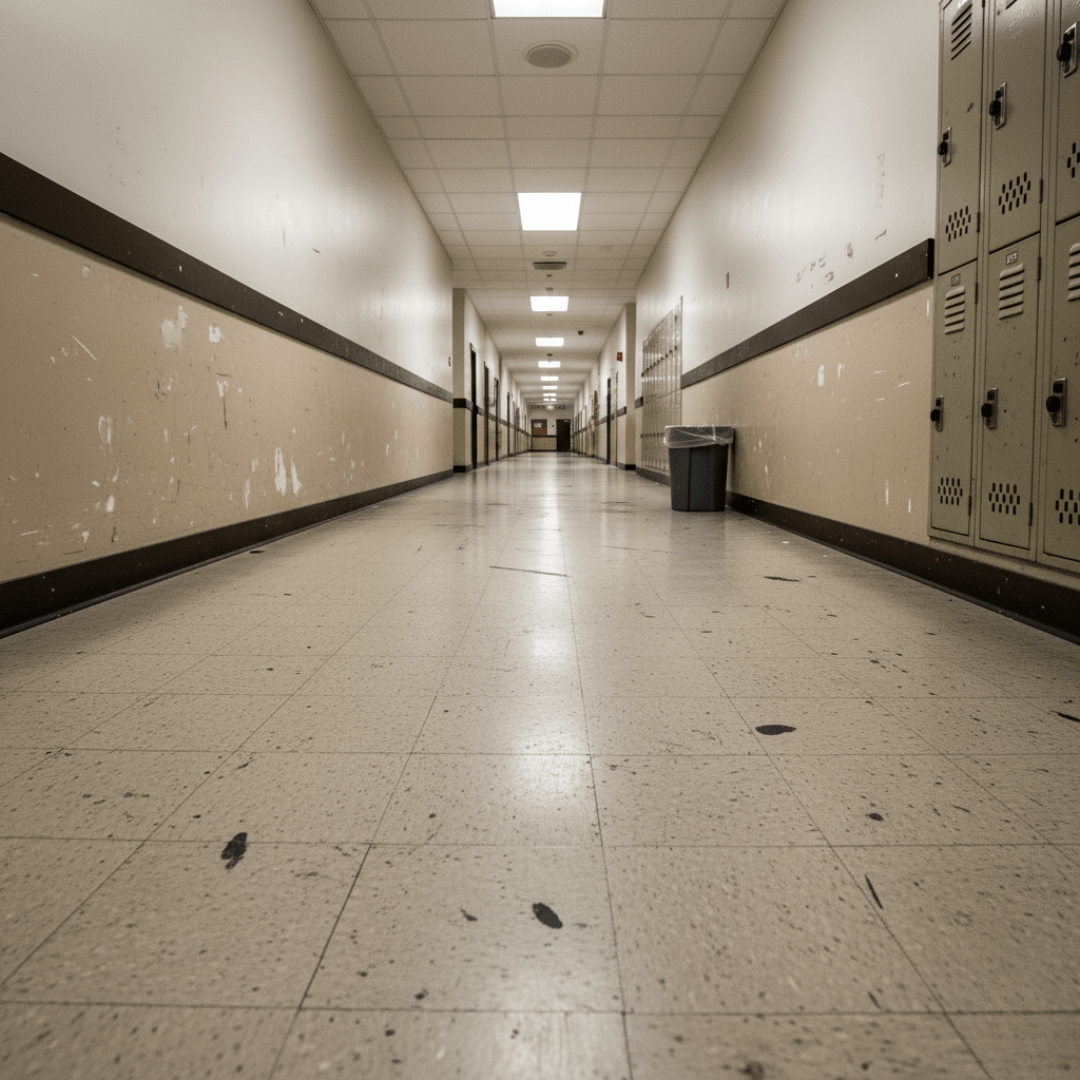
Why Do Our School Hallways Look Dull and Scuffed (Just Weeks After Finishing)?
Why Do Our School Hallways Look Dull and Scuffed (Just Weeks After Finishing)?
It’s the most demanding job in the facilities world: the “Summer Strip & Wax.”
Your maintenance team spends weeks of their summer break in an empty, echoing school. They painstakingly strip every inch of the old, yellowed floor finish. They apply coat after coat of new, high-gloss bulk floor finish. By the time they’re done, the hallways are gleaming. They shine like glass. You can see your reflection in them.
Then, the first day of school comes.
Within two weeks, it’s gone. The shine is “walked off.” The main hallways are dull, hazy, and covered in a spiderweb of black scuff marks and deep scratches. It looks like you haven’t waxed in a year, and your team’s hard work has been erased.
This is a deeply frustrating, expensive, and—worst of all—preventable problem.
If this is happening at your school, it’s not because your team is lazy or the students are “too hard” on the floors. It’s a systemic failure. You are either using the wrong products or the wrong process (or both).
That brilliant, lasting shine is not a “one-and-done” job; it’s a program. We’re going to diagnose exactly why your school hallways are failing and give you the professional floor care plan to fix it for good.
Part 1: The “Why” – Diagnosing the “Dull Hallway” Problem
Your school hallway is one of the most hostile environments a floor can exist in. It’s not just “high traffic”; it’s an abrasive environment. Your floor finish isn’t just a “shine layer”; it’s a sacrificial shield.
It’s failing for one of these three reasons.
Failure #1: Your #1 Enemy is “Grit” (And It’s Winning)
This is the main culprit. The #1 enemy of floor finish is the abrasive, sandy grit that’s tracked in from the parking lot, the playground, and the athletic fields.
- The Problem: You see a floor finish as a hard shell. But to that microscopic piece of sand on the bottom of a sneaker, your finish is a soft piece of plastic. With every footstep, that piece of sand is ground into the floor, creating a deep scratch.
- The “Dulling” Effect: Now, multiply that one piece of sand by 1,000 students, 10 times a day. After just one week, your “glossy” finish is no longer a smooth, reflective surface. It’s a hazy, abraded, scratched-up surface. It’s “dull” because the light is now scattering off those millions of tiny scratches.
- The Fix: You must stop the grit at the door. Your first line of defense isn’t a mop; it’s matting. A high-quality, commercial-grade matting system (a “scraper” mat outside, a “wiper” mat inside) will trap 80-90% of this abrasive soil before it ever hits your finished floor.
Failure #2: You’re Using the Wrong Floor Finish
Not all floor finish is created equal. If you bought your bulk floor finish based on the lowest “per-gallon” price, you probably bought the wrong product for a school.
- The Problem: You likely bought a “low-solids” (15%-18%) or “soft” finish. These finishes are great for a low-traffic office, but in a school, they simply can’t stand up to the abuse. They are too soft and abrade far too easily.
- The “Black Scuff Mark” Problem: Soft finishes are also “gummy.” When a black-soled shoe skids across them, the shoe bites into the soft finish, leaving a deep black scuff mark that is difficult to remove.
- The Fix: You need a finish that is built for school hallways. This means a high-solids (20-25%) or “high-durability” finish. We strongly recommend a proven “workhorse” like Betco Hard As Nails 17% soilds 5 gal. pail. [Editor’s Note: While named 17%, Hard As Nails is a unique, high-durability finish that cures harder than many 20% finishes, making it ideal for schools]. A harder, more durable finish is less likely to scratch and will resist scuffing.
Failure #3: You Have No “In-Season” Maintenance Program
This is the “one-and-done” mistake. You wax the floors in August and then… you just mop. You’re expecting that 5-coat sacrificial shield to last 9 months against a daily onslaught.
It won’t.
- The Problem: Daily mopping with a neutral cleaner only cleans the floor. It does not repair the millions of scratches. It does not remove the deep scuff marks. You are just mopping a clean, dull, scratched-up floor.
- The Fix: You must have a periodic maintenance plan. This is the “secret” of schools with shining floors. They aren’t stripping and waxing mid-year. They are burnishing.
- Burnishing: Is a process that uses a high-speed (1500+ RPM) machine and a special tan floor pad (or aqua burnishing pad).
- The Science: The intense speed and friction of the burnishing pad actually melts the top layer of your floor finish. This process smooths out all those microscopic scratches, buffs away scuff marks, and hardens the finish, polishing it back to a “wet look” shine.
Part 2: The “How” – The “Shine-All-Year” Floor Care Program
You can fix this. It requires a 3-part program: Prevention, Daily Maintenance, and Periodic Repair.
Step 1: Prevention (The “Summer Setup”)
Your success for the entire year is determined by what you do in the summer.
- Invest in Matting: Before school starts, install large, high-quality walk-off mats at every single entrance. This is a non-negotiable.
- Use the Right Finish: After you strip, apply 5-6 thin coats of a durable, high-solids, or “scrub & recoat” optimized bulk floor finish. This is your base.
- Buy the Right Floor Pads: You cannot run a building-wide floor care program with one box of red pads. Stock your supply closet with bulk floor pads for every job:
-
- Black floor pads: For summer stripping.
-
- Red floor pads (or Blue pads): For deep scrubbing.
-
- Tan burnishing pads: For your new periodic maintenance program.
Step 2: Daily Maintenance (The “Grit War”)
This is your daily defense. The goal is simple: Get the grit off the floor.
- Dust Mop: This is more important than mopping. A wide, microfiber dust mop must be run over all main hallways at least once a day, if not twice (once at midday, once at night). This removes the abrasive sand before it gets ground in.
- Vacuum: Use a backpack vacuum (like a POWR-FLITE) to vacuum all your entrance mats daily. A mat full of sand is no longer a mat; it’s a source of sand.
- Spot Clean: Mop spills immediately.
- Damp Mop: At night, after dust mopping, damp mop the floor with a neutral cleaner. This removes the fine dust and any sticky spills.
Step 3: Periodic Repair (The “Secret Weapon”)
This is the step you’re missing. This is how you “heal” the floor and bring back the shine. This should be done on a rolling basis (e.g., “A-Wing” gets it the first week of the month, “B-Wing” the second).
- Scuff Removal (Weekly):
-
- Action: Use a low-speed (175 RPM) floor machine and a red floor pad (3M Red Buffer Pad 5100).
-
- Process: “Spray buff” the hallways. This involves misting a small amount of spray buff solution or neutral cleaner and buffing the floor. The red pad is aggressive enough to scrub away most black scuff marks and surface scratches, restoring a clean, satin shine.
- Restoring the “Wet Look” (Monthly):
-
- Action: This is the game-changer. Use a high-speed (1500+ RPM) burnisher and a tan burnishing pad.
-
- Process: After the floor has been dust-mopped and cleaned, run the burnisher down the hallways. This is a dry process. The pad’s friction will pop that shine right back. It smooths the scratches, hardens the finish, and makes it look freshly waxed.
- The “Deep Heal” (Over Winter/Spring Break):
-
- Action: This is the “Scrub and Recoat.”
-
- Process: Use your low-speed floor machine with a more aggressive blue or green scrub pad. This deep-scrubs the floor and removes the top 1-2 coats of your finish, along with all the deep scratches and ground-in dirt. You then apply 2-3 new, fresh coats of your bulk floor finish.
-
- The Win: You’ve just restored your floor to “first day of school” condition without the massive labor and chemical cost of a full floor stripper job.
The Economics of a Smart Floor Care Program
This new plan might sound like more work. It’s not. It’s smarter work.
The “Old” Way (High Cost, Low Results):
- August: Massive labor/material cost for a full strip and wax.
- Sept-July: High labor for daily mopping, but the floors look terrible.
- July: Back to zero, massive labor/material cost to strip all 10 of those old, ruined coats of finish.
- Problem: You are paying 100% of the cost for a floor that only looks good 10% of the time.
The “New” Way (Smart, Rolling Maintenance):
- August: Labor/material cost for a strip and wax (5-6 coats).
- Sept-May:
-
- Daily dust mopping (fast, low-cost).
-
- Weekly spray buffing with a red pad (moderate labor).
-
- Monthly burnishing with a tan pad (fast, low-cost).
- Winter Break: Fast “Scrub and Recoat” (low material, moderate labor).
- July: Your summer strip is now 10x easier because you’re only stripping 7-8 coats of well-maintained finish, not 10 coats of caked-on, abraded grime.
- The Win: You are paying a slightly higher maintenance cost, but your floors look good 90% of the time, and your total annual cost (especially in labor for the summer strip) will be lower.
Your school hallways don’t have to be a source of embarrassment. A dull, scuffed floor is a sign of a failed strategy.
By investing in preventative matting, using a durable bulk floor finish like Betco Hard As Nails, and—most importantly—implementing a periodic maintenance plan with the right bulk floor pads, you can protect your team’s hard work and keep your school shining all year long.
Ready to build your “Shine-All-Year” program? Shop our full collection of floor care supplies, from high-durability bulk floor finish to the commercial-grade floor pads and vacuums you need to win the war on grit.