
Why Are Your Trash Bags Tearing? You’re Buying the Wrong Liners for Your Business
Why Are Your Trash Bags Tearing? You’re Buying the Wrong Liners for Your Business
It’s the single most frustrating moment in a janitorial or foodservice operation.
A staff member goes to pull the trash. The bag, full of the day’s waste, lifts an inch… and rips. A disgusting mess of coffee grounds, half-eaten food, and sticky liquids pours out onto the floor and down the sides of the trash can.
What was a 30-second task has just become a 20-minute, hazardous cleanup. Your employee is frustrated and demoralized. You’ve just created a dangerous slip-and-fall hazard. And to add insult to injury, you now have to double-bag the new liner, which means you’re literally paying twice for a product that already failed you.
Who do you blame? The employee for “overfilling” it? The bag for being “cheap”?
The hard truth is that the fault lies with procurement. The bag didn’t fail. You bought the wrong bag for the job.
This is the most common mistake we see in the bulk janitorial supplies industry. Most managers buy bulk trash liners based on two factors: gallon size and price. They see a 40-gallon bag for a 40-gallon can, and they pick the cheapest one.
This is like buying a “sedan” for a “construction site.” It fits, but it’s going to fail spectacularly.
If your trash bags are tearing, splitting, or puncturing, this guide is for you. We’ll explain exactly why it’s happening and how to choose the right bulk trash liners to ensure it never happens again.
The Root of the Problem: You’re Buying an Office Bag for a Kitchen Job
Not all trash is created equal. The paper in an office wastebasket is fundamentally different from the waste in a restaurant kitchen. Therefore, the bags designed to hold them are made from two fundamentally different plastics.
If your bags are ripping, it’s almost certainly because you are using an HDPE bag when you must be using an LLDPE bag.
The “Crinkly” Bag (HDPE) – Built for Paper, Not Pokes
- Name: HDPE (High-Density Polyethylene)
- What It Is: This is the thin, “crinkly” bag. It’s the bag you find in an office, a hotel room, or a restroom.
- Why It’s Strong: It has high “tensile strength,” which means it can hold a lot of weight (like a can full of paper) as long as nothing sharp pokes it.
- Why It Fails: It has zero “give” or “stretch.” The moment a sharp object—a plastic fork, a staple, a sharp box corner, a bone—pokes it, the bag tears. It doesn’t just get a small hole; it “zips” open in a straight, disastrous line.
If you’re using this bag in your breakroom, kitchen, or for general-purpose trash, you are guaranteed to have failures.
The “Stretchy” Bag (LLDPE) – Built for Pokes, Not Paper
- Name: LLDPE (Linear Low-Density Polyethylene)
- What It Is: This is the thick, “stretchy,” and quiet bag. It’s your classic heavy-duty trash bag.
- Why It’s Strong: It has incredible puncture and tear resistance.
- The Science: Its molecules are loosely packed, giving it “stretch-factor.” When a sharp object pokes it, the bag’s material stretches and wraps around the object instead of tearing.
- Why It’s the Solution: This bag is designed for the chaos of a kitchen, cafeteria, or construction site. It can handle sharp plastic cutlery, heavy wet food, foil containers with sharp edges, and bulky, oddly-shaped objects without breaking a sweat.
The Bottom Line: If your trash contains anything sharp, anything heavy and wet, or anything bulky and oddly-shaped, you must use an LLDPE bag.
It’s Not Just the Plastic, It’s the Thickness (Mil vs. Micron)
The second reason for failure is choosing the wrong thickness. The industry uses two different measurements, and they are not interchangeable.
- HDPE (Crinkly) bags are measured in Microns.
- LLDPE (Stretchy) bags are measured in Mils.
“Mil” is not millimeters. It’s 1/1000th of an inch. A higher Mil means a thicker, more puncture-resistant bag.
Why Your “Heavy-Duty” Bag Isn’t Heavy-Duty
This is a common trap. You see an HDPE bag that says “16 Micron.” You see another that says “22 Micron.” You think, “Wow, 22 must be super strong!”
It is strong… for paper. A 22 Micron HDPE bag is a “heavy-duty” bag for an office. It will hold a ton of paper. But a 22 Micron bag is only about 0.85 Mil thick.
Now, let’s look at a true heavy-duty trash bag for a kitchen.
A standard kitchen LLDPE bag is 1.5 Mil.
1.5 Mil is almost double the thickness of that “heavy-duty” 22 Micron bag. And it comes with all the stretch and puncture-resistance of LLDPE.
If your bags are ripping, you’re not just using the wrong type (HDPE), you’re using a bag that is half as thick as the job actually requires.
Your 3-Step Plan to a Rip-Proof Operation
Ready to solve this problem forever? It’s a simple, three-step fix.
Step 1: Audit Your Trash
Look in your cans. Don’t just guess.
- Office/Restroom Cans: Is it 99% paper, tissues, and wrappers? This is an HDPE (Micron) job.
- Kitchen/Breakroom/Cafeteria Cans: Do you see plastic forks? Food scraps? Wet grounds? Sharp-edged cans or boxes? This is an LLDPE (Mil) job. No exceptions.
- General/Outdoor Cans: Is the trash unpredictable? Bulky? Chance of sticks or glass? Default to LLDPE (Mil) for safety.
Step 2: Choose Your Power (The Mil)
For your LLDPE bags, choose your thickness.
- 1.1 – 1.2 Mil: Great for a busy breakroom or a household kitchen. A solid, all-purpose workhorse.
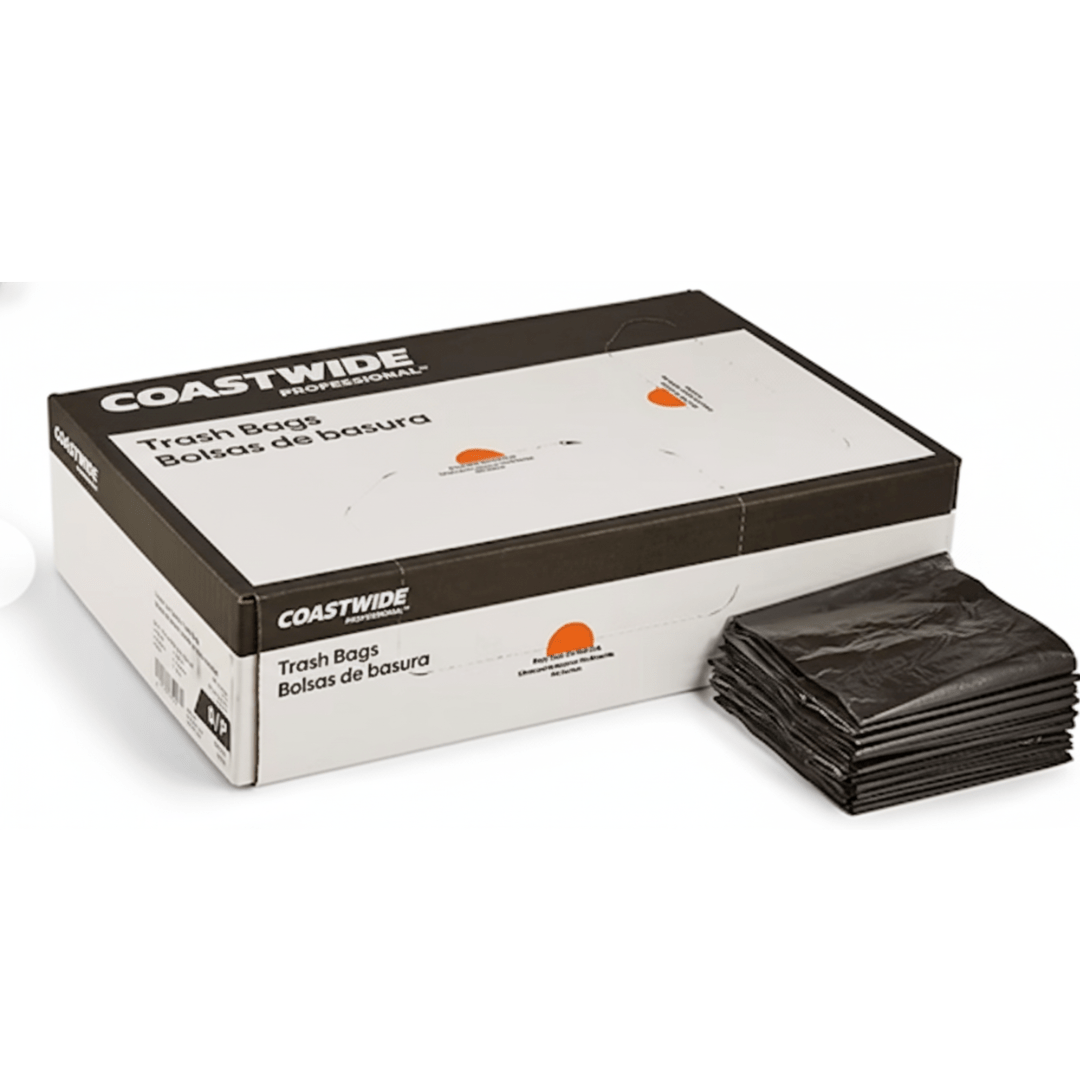
- 1.5 Mil: This is the professional standard for bulk kitchen supplies. It’s the “sweet spot” of cost and performance, built to handle the demands of a restaurant kitchen. Our 40 Gallon Trash Bags Black 1.5 Mil are a perfect example.
- 2.0 Mil+: This is for “extra-heavy-duty” needs like construction debris, sharp-edged industrial waste, or landscaping (sticks and rocks).
Step 3: Buy from a Real Supplier
The “bargain bags” at warehouse clubs are almost always thin, low-grade LLDPE or, more commonly, just standard HDPE bags. They are a “one-size-fits-all” product that is not optimized for professional use.
To get the right bag, you need to buy from a bulk janitorial supplies expert. We stock the full range of bulk trash liners because we know that a 1.5 Mil LLDPE bag and an 8 Micron HDPE bag are two completely different tools for two completely different jobs.
Stop Paying for Clean-Up. Start Paying for Performance.
That “cheap” case of 500 trash liners (that are the wrong type) isn’t saving you money.
- It costs you 20 minutes of labor for every rip.
- It costs you double in product when you have to double-bag.
- It costs you in safety and morale when your staff has to clean up a disgusting, hazardous mess.
Stop the cycle of “rip and replace.”
Invest in the right tool for the job. A 1.5 Mil LLDPE heavy-duty trash bag in your kitchen is not an “expense”—it’s an investment. It’s a guarantee that the trash you put in the can stays in the can.
Ready to end the “rip” for good? Shop our full collection of bulk trash liners and talk to our experts. We’ll help you analyze your waste stream and outfit you with the perfect, cost-effective, and rip-proof liner for every can in your building.