Why Is Our Disinfectant Failing to Stop Outbreaks? (The 4-Step Fix)
Why Is Our Disinfectant Failing to Stop Outbreaks? (The 4-Step Fix)
It’s the scenario that keeps facility managers, principals, and office administrators up at night.
An outbreak.
First, one person in accounting is out with the flu. Then three from sales. By the end of the week, your school or office is a ghost town. You have a full-blown outbreak on your hands, and productivity has crashed to zero.
The most frustrating part? You thought you were prepared. Your janitorial team is working overtime. They’re “disinfecting” every surface, every night. You can smell the bleach in the air. You’ve approved the POs for extra bulk cleaning supplies.
And yet… people are still getting sick.
You’re left asking the million-dollar question: Why is our disinfectant failing?
Here is the hard, clinical truth: The disinfectant is not failing. Your process is.
That powerful, EPA-registered bulk disinfectant you bought has the power to kill 99.999% of viruses and bacteria. But it’s not a magic wand. It’s a precise chemical tool with rules.
The most common “cleaning” process in the world—the “spray and wipe”—is 100% ineffective for killing viruses. You’re not disinfecting. You’re just cleaning. You’re wiping germs around, giving yourself a false sense of security while the real threat remains.
This guide will break down the 4 critical mistakes your team is making and provide the “No-Fail” professional disinfection protocol that will actually stop an outbreak in its tracks.
Part 1: The “Why” – The 4 Reasons Your Disinfection Is Failing
Your team is working hard, but they’re not working smart. They’re almost certainly making one of these four critical, invisible errors.
Failure #1: You Are Ignoring “Dwell Time” (The #1 Mistake)
If you learn only one thing, let it be this.
- What is Dwell Time? Dwell Time (or “Contact Time”) is the legally-mandated amount of time a surface must remain visibly wet with the disinfectant to achieve its 99.999% kill claim.
- The Common Error (The “Spray-and-Wipe”): Your cleaner sprays the desktop. They immediately wipe it dry with a paper towel.
- The Result: The disinfectant was on the surface for 3 seconds. But the kill time for Norovirus or Influenza on that product’s label might be 5 to 10 minutes.
- The Hard Truth: You just did nothing. You didn’t kill a single virus. You just moved the germs around on a damp, dirty cloth. You get all the chemical smell with none of the germ-killing benefit.
A disinfectant is not a bullet; it’s a poison. It needs time to work. It has to sit on the germ and chemically destroy it. If you wipe it away before the Dwell Time is up, the germ lives on, ready to infect the next person who touches the surface.
Failure #2: You’re Not Cleaning Before You Disinfect
You can’t kill a germ you can’t touch.
- The Problem: Your janitor goes to “disinfect” a visibly dirty conference table. It’s covered in coffee rings, dust, and a fine layer of grime. They spray the disinfectant right on top of the mess.
- The Science: Disinfectant is “used up” by organic matter. The chemicals in the disinfectant attack the first thing they touch. If that’s a layer of dust, dirt, or a sticky “bio-film” from a coffee spill, the disinfectant will be 100% neutralized by that grime before it ever gets a chance to touch the germs living safely underneath.
- The Analogy: This is like trying to mop a floor without sweeping it first. You’re just creating a “germ-and-dirt soup.” You must clean first, then disinfect.
Failure #3: You’re Using the Wrong Product (Sanitizer vs. Disinfectant)
This is a critical error in procurement. You see a case of “Surface Sanitizer” on sale and buy it.
- The Problem: You are bringing a knife to a gunfight.
- Sanitizer (Kills 99.9%): A sanitizer is legally defined as a product that reduces bacteria to a safe level. It typically makes no claim to kill viruses. It’s for food-contact surfaces.
- Disinfectant (Kills 99.999%): A disinfectant is an EPA-registered “pesticide” (germ-killer) designed to eliminate pathogens. This is the only product that is legally proven to kill viruses like Influenza, Norovirus, and SARS-CoV-2.
- The Result: You are wiping your desks with a product that is chemically incapable of killing the flu virus that’s spreading through your office.
Failure #4: You’re Missing the “Hot Zone” Touchpoints
Your team is doing a great job on the “big four”: desktops, floors, sinks, and toilets. But they are completely missing the real germ highways.
- The Problem: Germs don’t just live on big, flat surfaces. They are transmitted by the small surfaces everyone touches in common.
- The “Hot Zone” Hit List:
-
- Light Switches (the #1 most-missed spot)
-
- Doorknobs & Push-Plates (especially the inside of the restroom door)
-
- Elevator Buttons
-
- Stairwell Handrails
-
- Refrigerator, Microwave, and Coffee Pot Handles
-
- Copier/Printer Touch-Screens
-
- Conference Room Phones & TV Remotes
An outbreak is spreading because one sick person touched the elevator button, and the 50 people who touched it after them are now carriers. You’re not stopping the outbreak because you’re not disinfecting the path of transmission.
Part 2: The “How” – The 4-Step “No-Fail” Disinfection Protocol
Okay, you’ve diagnosed the problem. Here is the professional-grade, 4-step process to fix it. This is not “harder”; it’s just smarter.
Step 1: Get the Right Arsenal
Your process is only as good as your tools.
- The Right Chemical: Stop buying “sanitizers” for this job. You need a true, EPA-registered bulk disinfectant. A ready-to-use (RTU) product like Clorox Clean-Up Disinfectant Cleaner is excellent because its “cleaner” and “disinfectant” are in one, and it has fast, clear Dwell Times on the label.
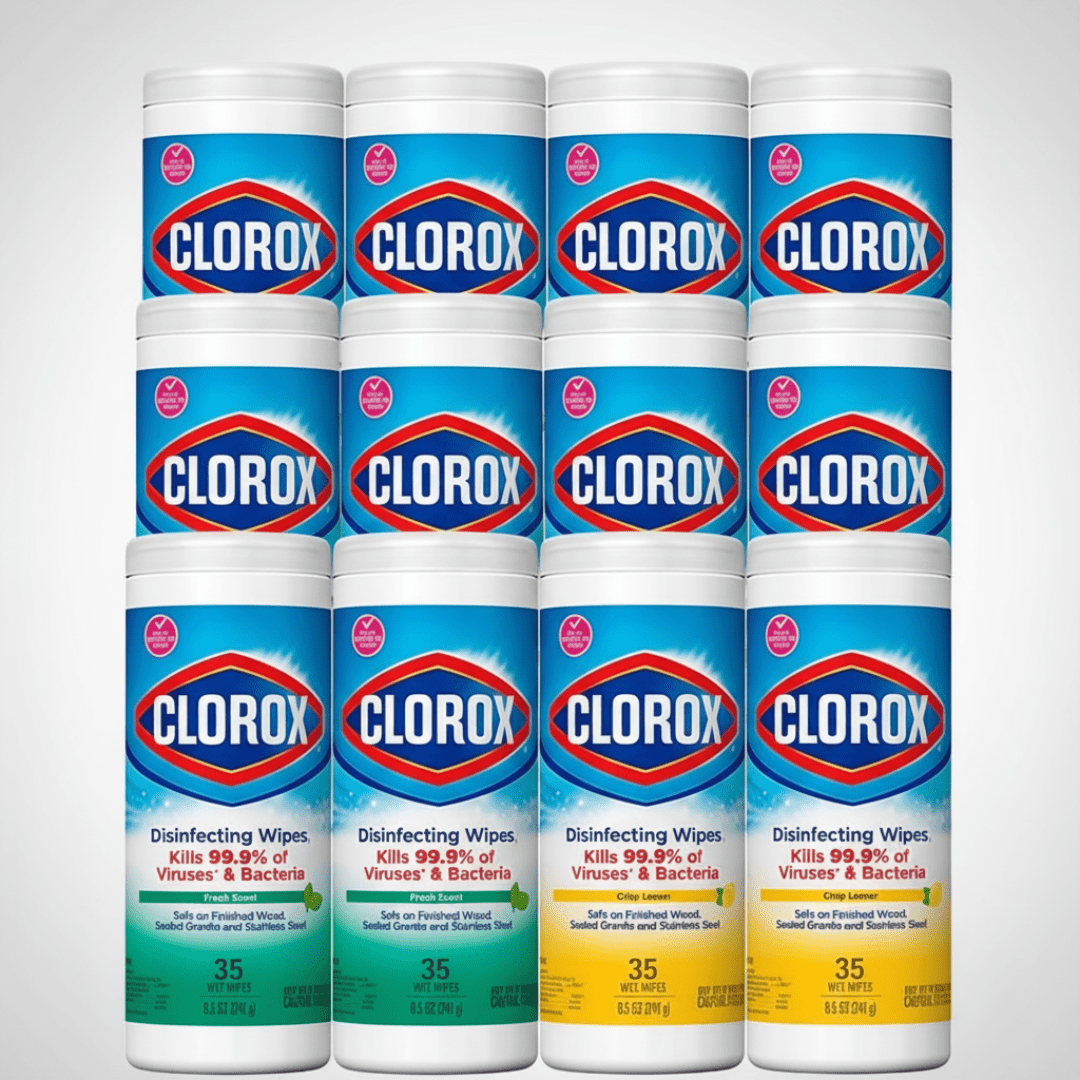
- The Right “Spot” Tools: Disinfectant Wipes are your best friends. They are the perfect tool for your team to quickly hit all those “Hot Zone” touchpoints (doorknobs, light switches, etc.). They are also great to leave in conference rooms and kitchens to empower employees to clean up after themselves.
- The Right Cloths: Ditch the brown paper towels. You need microfiber. Better yet, use color-coded cloths: Red for restrooms (high-risk), Blue for general surfaces (desks, offices), Green for kitchens. This is a non-negotiable pro-level tactic to prevent cross-contamination (i.e., wiping a desk with the same cloth used on a toilet).
Step 2: The “Two-Step” Process (Clean THEN Disinfect)
This is the new rule.
- Step 2A: CLEAN. Take your “Blue” microfiber cloth and an all-purpose cleaner (or just soapy water). Wipe the surface (e.g., the conference table) to remove all visible dust, coffee rings, and grime. Now you have a clean surface.
- Step 2B: DISINFECT. Take your disinfectant spray (or a new, clean disinfectant wipe) and apply it liberally to the clean surface.
Step 3: Master the Dwell Time
This is the step that makes it work.
- Action: Apply the disinfectant so the surface is visibly wet.
- Action: Read the label. Let’s say the Dwell Time for Influenza virus is 5 minutes.
- Action: Look at your watch.
- The New Workflow: Do not “spray and wipe” one desk at a time. Work in a “batch.”
-
- CLEAN all 5 desks in a pod.
-
- Go back and DISINFECT (spray) all 5 desks until they are wet.
-
- Go clean the filing cabinets or bookshelves.
-
- After 5+ minutes have passed, return to the desks. If the label requires a rinse, wipe them down with a clean, damp cloth. If it’s a “no-rinse” formula, you can let it air dry.
Step 4: Attack the “Hot Zones”
This is the final, 10-minute “sweep” that actually stops the outbreak.
- Action: This is the perfect job for disinfectant wipes.
- The New Workflow: Give your cleaner a canister of wipes and this list. Their last task of the night is to do a “Hot Zone Hit.”
-
- Wipe the light switches.
-
- Wipe the doorknobs.
-
- Wipe the elevator buttons.
-
- Wipe the kitchen handles.
-
- …and so on.
This 10-minute task, done correctly, is more effective at stopping an outbreak than 2 hours of mopping.
From “Cleaning for Show” to “Cleaning for Health”
An outbreak in your facility is a clear sign that your process has failed. You were “cleaning for show”—making things look and smell clean. You must now start “cleaning for health”—which is a scientific process.
The fix is simple:
- Clean First, Disinfect Second.
- Use the Right Product (a true disinfectant or disinfectant wipe).
- Respect the Dwell Time.
- Attack the Hot Zones.
This new protocol doesn’t just stop outbreaks. It reduces absenteeism, boosts productivity, and sends a powerful message to your employees or students: their health is your priority.
Ready to build a “No-Fail” disinfection program? Shop our complete collection of EPA-registered bulk disinfectant, disinfectant wipes, and all the bulk cleaning supplies you need to “clean for health.”