
The Floor Pad Color Code Explained: A Pro’s Guide to Not Ruining Your Floors
The Floor Pad Color Code Explained: A Pro’s Guide to Not Ruining Your Floors
In the world of professional floor care, one small mistake can cost you thousands of dollars and dozens of hours in labor. It’s the difference between a floor that shines like glass and a floor that’s dull, hazy, or worse—completely stripped of its protective finish.
What’s the mistake? Using the wrong floor pad.
To an untrained eye, all floor pads look the same, just in different colors. But to a professional, those colors are an essential, industry-standard language. They communicate a pad’s specific job, from aggressive, heavy-duty stripping to gentle, high-gloss polishing.
Using the wrong pad is like trying to wash your car with sandpaper. You’re not just doing the job incorrectly; you’re actively causing a disaster.
If you’ve ever been confused about whether to use a black, red, blue, or tan pad, this guide is for you. We are going to demystify the floor pad color code once and for all. By the time you’re done, you’ll be able to confidently walk up to any floor machine, select the right pad for the job, and achieve professional, brilliant results every single time.
Why the Color Code Is a $1,000 Mistake Waiting to Happen
Let’s establish what a floor pad actually is. It’s not a mop. It’s a disc of abrasive material designed to spin at high speeds. Think of it as specialized sandpaper for your floor’s finish. Just like sandpaper, floor pads come in different “grits” or levels of aggressiveness.
The color code is simply a universal way to identify that aggressiveness. Darker colors are more aggressive. Lighter colors are less aggressive.
Here’s the $1,000 mistake:
A facility manager wants to clean scuff marks off the lobby floor before a big event. They tell a new employee to “buff the floor.” The employee, not knowing the code, grabs a black floor pad because it “looks heavy-duty.”
They’ve just used a stripping pad.
In ten minutes, they haven’t just “buffed” the scuffs; they have completely removed all 5-6 layers of your expensive floor finish, grinding right down to the bare tile. A 10-minute buffing job has just turned into an 8-hour, all-night emergency strip and wax.
That’s why the color code matters. It’s the single most important thing to learn in floor care—the crucial link between your machine, your chemical, and your floor.
The Floor Pad Spectrum: From Stripping to Shining
Let’s walk through the color spectrum, from the most aggressive pads to the gentlest. We’ll cover their purpose, what machine to use them on, and the pro-level product they’re designed to work with.
Important Note: Most of these pads (especially the aggressive ones) are designed for low-speed (175-300 RPM) floor buffers or “swing machines.” High-speed burnishing pads are a separate category, which we’ll cover at the end.
1. Black Pads = Aggressive Stripping
- Name/Category: Stripping Pad
- Aggressiveness: Extremely High
- Primary Use: The nuclear option. This pad is for total finish removal only. Its job is to grind through multiple, caked-on layers of old floor finish, wax, and sealer, taking you down to the bare VCT, tile, or terrazzo.
- When to Use It: You use this pad during a “strip and wax” job, and only after applying a liberal amount of bulk floor stripper. The chemical does the work of melting the finish, and the black floor pad does the work of scrubbing it all away.
- Machine Speed: Low Speed (175-300 RPM).
- Pro-Tip: NEVER use this pad for any kind of cleaning or buffing. It will instantly erase your finish. The industry-standard is the 3M 7200 Black Stripping Floor Pads, which is designed for maximum removal with minimal effort.
2. Green / Blue Pads = Deep Scrubbing
- Name/Category: Deep Scrub Pad or Aggressive Cleaning Pad
- Aggressiveness: High
- Primary Use: This is a step down from black but still very aggressive. A blue cleaning pad is for deep, heavy-duty scrubbing. It’s designed to remove caked-on dirt and grime without removing all your finish.
- When to Use It: Use this for a “scrub and recoat.” This is when your floors are in decent shape, but the top 1-2 layers of finish are dirty or scuffed. The blue pad scrubs off that dirty top layer, preparing the floor for 1-2 fresh coats of floor finish. It’s also used for cleaning heavily soiled concrete or industrial floors.
- Machine Speed: Low Speed (175-300 RPM).
- Pro-Tip: While less aggressive than black, a blue pad will still remove a significant amount of finish. Do not use it for daily cleaning.
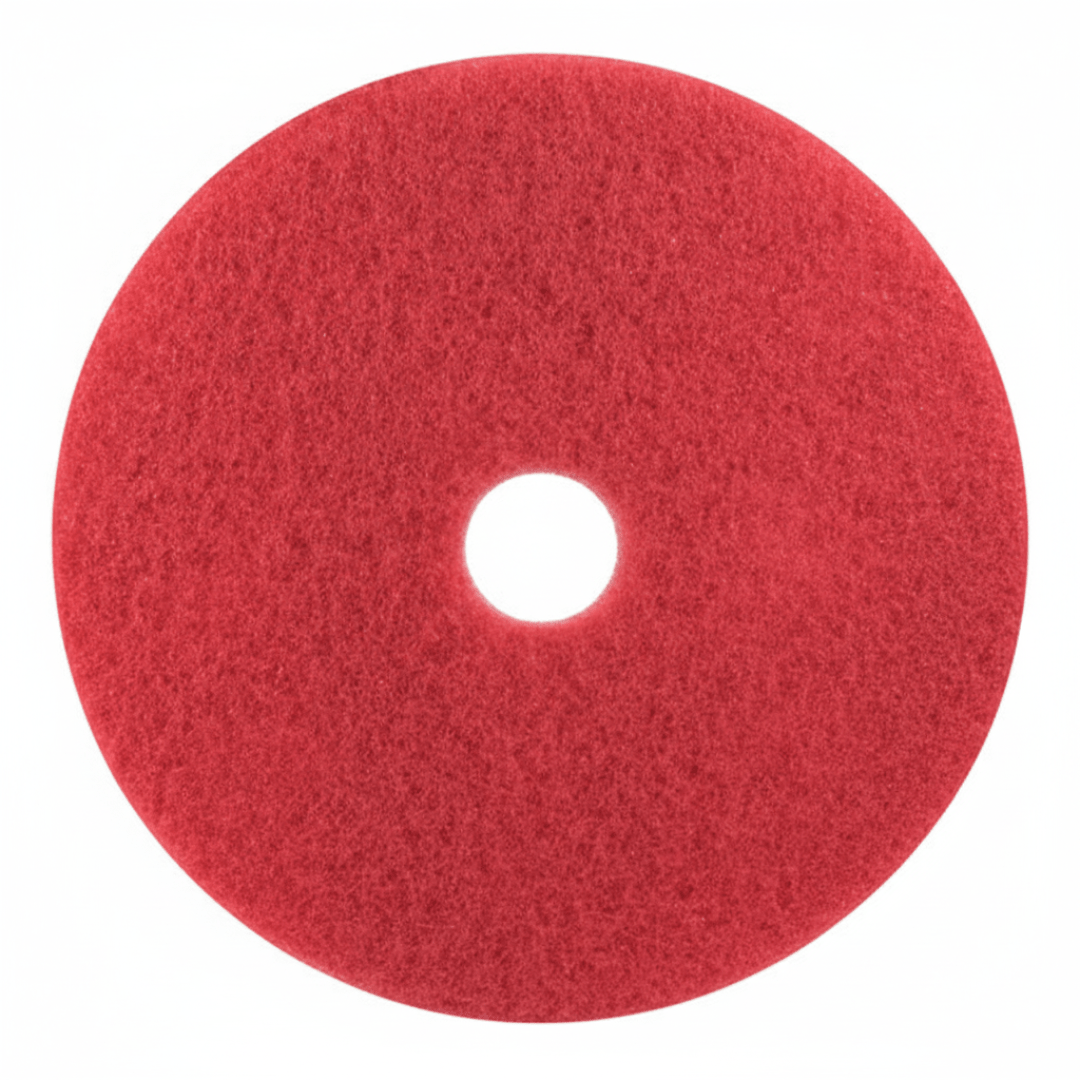
3. Red Pads = Light Cleaning & Spray Buffing
- Name/Category: Buffing Pad or Spray Buffing Pad
- Aggressiveness: Medium
- Primary Use: This is your daily or weekly workhorse. The red floor pad is the standard for routine cleaning and scuff removal. It has just enough grit to scrub away black scuff marks, spills, and ground-in dirt without damaging your base layers of finish.
- When to Use It: Use this pad with a neutral floor cleaner for daily/weekly mopping with a floor machine (an “auto-scrubber”). Its most popular use is for “spray buffing,” where you mist a special buffing solution on the floor and the red pad buffs it to a clean, satin shine.
- Machine Speed: Low Speed (175-300 RPM).
- Pro-Tip: The 3M Red Buffer Pad 5100 is the most common floor pad in any janitorial closet. If you want to clean a floor without stripping it, this is your go-to.
4. White Pads = Polishing & “Dry Buffing”
- Name/Category: Polishing Pad
- Aggressiveness: Very Low
- Primary Use: This pad has almost no “grit.” It’s a non-abrasive, soft pad. Its only job is to polish a clean, dry floor to a higher shine.
- When to Use It: Use this pad after you’ve already cleaned the floor with a red pad. You run the white pad “dry” (with no chemical) to buff the finish to a soft, lustrous gloss. It’s also used to “buff out” any haziness or light scratches in a fresh coat of finish.
- Machine Speed: Can be used on Low or High Speed (1500+ RPM) machines.
- Pro-Tip: This is a polishing pad, not a cleaning pad. Running it over a dirty floor will just grind the dirt into your finish.
5. Tan / Aqua Pads = High-Speed Burnishing (The “Wet Look”)
- Name/Category: Burnishing Pad
- Aggressiveness: N/A (Uses Frictional Heat)
- Primary Use: This is a completely different category. A tan burnishing pad is not designed to scrub. It’s designed for High-Speed Burnishers (1500-2500+ RPM). The extreme speed and friction melt and harden the floor finish, polishing it to a brilliant, “wet look” high gloss.
- When to Use It: Use this only on a clean, dry floor with a high-speed burnisher. This is the final step in a floor care program that creates the mirror-like shine you see in hospitals, airports, and high-end grocery stores.
- Machine Speed: High Speed ONLY (1500+ RPM).
- Pro-Tip: Using a tan burnishing pad on a low-speed machine will do absolutely nothing. Conversely, using a black floor pad on a high-speed machine will destroy the pad and potentially the machine. Products like the 3M Aqua Burnish Pad 3100 are specifically engineered to use heat and friction to produce that coveted shine.
Quick-Reference Chart: The Floor Pad Color Guide
For quick reference, here’s a simple chart. Bookmark this page or print this for your janitorial closet.
| Color | Name | Aggressiveness | Machine Speed | Primary Job |
| Black | Stripping Pad | Very High | Low (175-300 RPM) | Total Finish Removal (with stripper) |
| Green/Blue | Deep Scrub Pad | High | Low (175-300 RPM) | Deep Clean / Recoat Prep |
| Red | Buffing Pad | Medium | Low (175-300 RPM) | Daily Cleaning & Scuff Removal |
| White | Polishing Pad | Very Low | Low or High Speed | Light Polish / “Dry Buff” |
| Tan / Aqua | Burnishing Pad | N/A (Friction) | High Speed ONLY (1500+ RPM) | High-Gloss “Wet Look” Shine |
Beyond Color: Choosing the Right Pad Size
One final pro-tip: you can’t just buy a “red pad.” You must buy the floor pad that matches the size of your cleaning equipment.
Floor machines come in standard sizes, most commonly 17-inch, 19-inch, or 20-inch. The pad MUST match the machine. A 17-inch pad on a 20-inch machine will be ineffective and wobble, while a 20-inch pad on a 17-inch machine won’t fit.
Always check the size of your machine’s “pad driver” (the plate the pad attaches to) before ordering.
From Confused to Confident
The floor pad color code is no longer a mystery. It’s a simple, logical system that empowers you to get the exact result you want, every time. You now know that black is for stripping, red is for cleaning, and tan is for burnishing—and you know the disastrous consequences of mixing them up.
Using the right floor pad is the key to a professional, efficient, and cost-effective floor care program. It protects your floors, saves you countless hours of labor, and ensures your facility always looks its absolute best.
Stop guessing and start shining. Explore our complete collection of professional, bulk floor pads and floor care supplies today, or contact our team of experts to build the perfect, cost-saving program for your facility.